
Frankencoin — Swiss Franc Stablecoin (ZCHF)

Digital. Decentralized. Neutral.
Frankencoin is the largest and most successful Swiss franc stablecoin.

INTRODUCTION
What is Frankencoin?
Frankencoin is a stablecoin that tracks the value of the Swiss franc.
Swiss Franc Stablecoin
Frankencoin (ZCHF) is a digital currency that maintains a stable 1:1 value with the Swiss franc. It combines the stability of Switzerland's trusted currency with the transparency and openness of the blockchain.
Fully Decentralized
Unlike centralized stablecoins, the value of the Frankencoin does not depend on an issuer that guarantees its value. Instead, the Frankencoin is backed by on-chain collateral that can be liquidated if necessary to maintain its value.
Live and Established
Frankencoin has been deployed on 8 different blockchains. It is the largest and most popular Swiss franc stablecoin, enabling on-chain transactions in Swiss francs since 2023 with no significant deviations from its peg.

Now live
Frankencoin Shares (FCS)
The canonical governance and share token of Frankencoin.
- Equity participation
- Participate in the system's equity reserve, which absorbs protocol income and losses.
- Time-weighted governance
- Build voting power over time and participate directly or delegate your votes.
- 1:1 FPS wrapping
- Wrap existing FPS one-to-one into FCS. FPS remains the underlying Equity token.
WAYS TO USE FRANKENCOIN
Pay. Borrow. Earn. Build.
Pay

Use Frankencoin for Swiss franc payments—at Spar stores, via debit cards (GnosisPay), or with IBAN integration (Mt Pelerin). Pay bills, receive salary, and make everyday purchases.
Borrow

Borrow Frankencoin by depositing crypto assets as collateral. Access ZCHF liquidity while maintaining exposure to your digital assets.
Borrow ZCHF

Earn

Earn market-based yield on your ZCHF holdings through DeFi applications. Put your Frankencoin to work generating returns.
Earn yield on ZCHF
Build & Integrate

Developers and businesses can integrate Frankencoin as a programmable Swiss franc layer for applications and financial services.
View Documentation
Notable Frankencoin Use-Cases
Exchanges & On-Ramps
Frankencoin (ZCHF) is available on a range of platforms—from regulated Swiss on-ramps to decentralized exchanges. Whether you prefer a bank transfer or a direct swap, there is a convenient way to obtain ZCHF.

Swiss-regulated on-ramp: buy ZCHF directly with a bank transfer via your personal IBAN. Fully compliant and beginner-friendly.

Swiss-based service for buying and selling ZCHF with bank transfers. Simple, compliant, and non-custodial—your keys, your coins.

Leading decentralized exchange optimized for stablecoins. Swap ZCHF with low slippage and deep liquidity on Ethereum.

The most widely used decentralized exchange. Trade ZCHF permissionlessly on Ethereum and other networks with full transparency.

Intent-based swap routing across DeFi liquidity. Swap USDC into ZCHF through optimized execution paths on Ethereum.

MEV-protected decentralized exchange. Batch auctions find you the best available price for your ZCHF trades automatically.
HOW FRANKENCOIN WORKS
The Frankencoin System at a Glance
Frankencoin is a fully transparent, rule-based, decentralized, modular, and neutral financial infrastructure.
Mint
Sell
Spend
Save
Invest
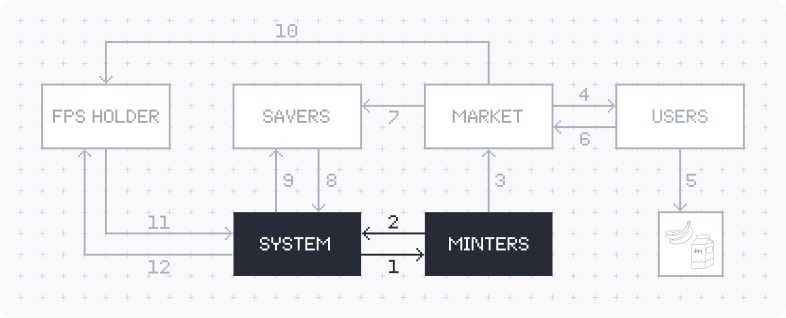
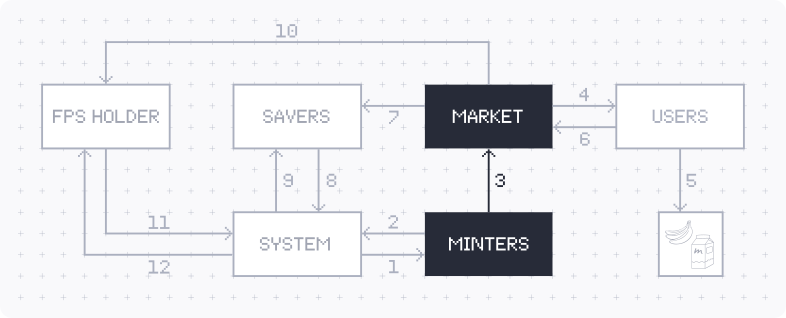
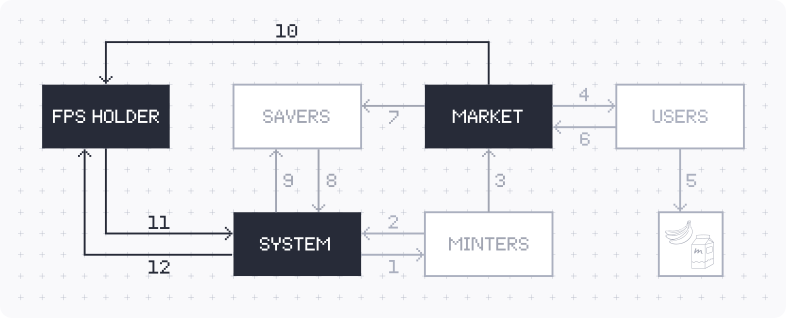
1 Mint
Frankencoins can be created by anyone that deposits a suitable collateral.
2 Burn
The collateral remains locked until its owner returns the created Frankencoins (plus fees) again.
3 Sell
Newly minted Frankencoins are typically sold in the market.
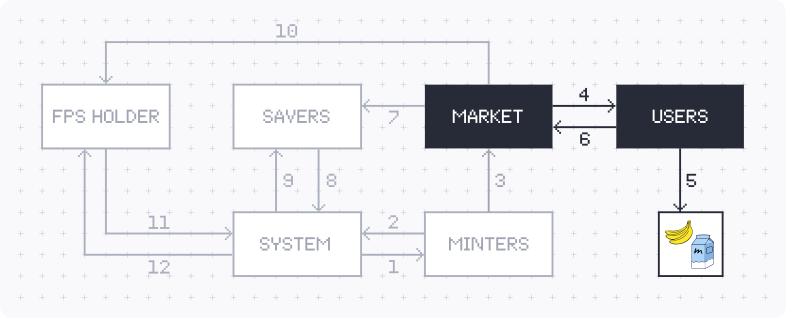
4 Buy
Users can buy Frankencoins on various trading venues.
5 Pay
They might want to use Frankencoins to make Swiss franc payments in DeFi or elsewhere.
6 Sell
Recipients may want to sell the collected Frankencoins again.
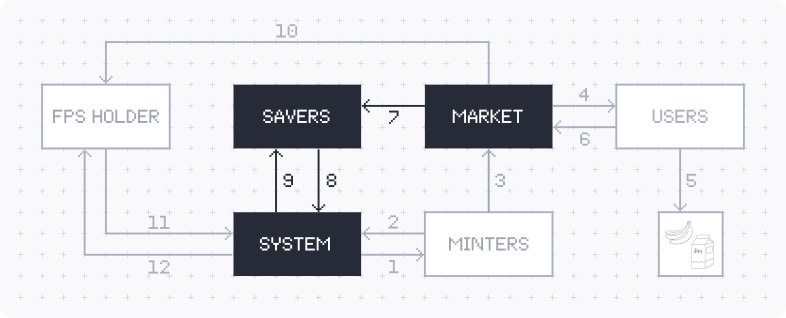
7 Buy
When swapping Swiss francs into Frankencoins on the market,
8 Save
and then storing them in the savings module,
9 Interest
users can earn an attractive interest.
10 Buy
Users can invest ZCHF through FCS to support the system's equity reserve.
11 Contribute
The FCS contract invests in the underlying Equity token, FPS, and issues one FCS per FPS.
12 Redeem
Redemption into ZCHF depends on the contract's eligibility rules, pricing curve, fees and redemption discount.
Collateralized debt position
Frankencoin operates as a decentralized collateralized debt position system. Users deposit crypto assets as collateral to mint digital Swiss francs (ZCHF). The collateral remains under the user's control while securing the outstanding franc issuance, similar to a secured lending facility with transparent, automated terms.
How to open a position Why 1 ZCHF equals 1 CHF
Frankencoins are over-collateralized, such that each Frankencoin is always backed by at least one Swiss franc worth of assets. The assets backing the Frankencoins are publicly visible on-chain.
Inspect the reserves Market-driven price stability
The system is designed to keep the long-term value of the Frankencoin in line with the Swiss franc. This means that every short-term deviation is an arbitrage opportunity for the market to exploit, thereby keeping the exchange rate close to parity.
How auctions work Theoretical Foundation
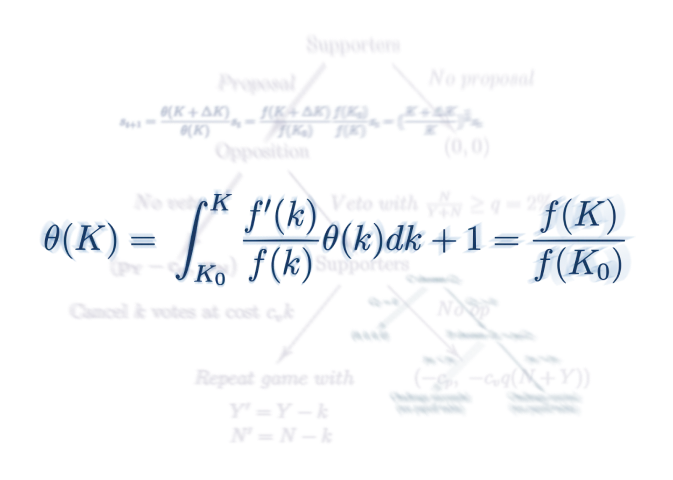
The Frankencoin was conceived a part of a PhD thesis completed at the Department of Finance at the University of Zurich. Among other things, it covers the game theory behind the system's novel liquidation mechanism, quantifies the risk of Bitcoin as a collateral, and it formally analyses the veto-based governance system. The Frankencoin system can be seen as a Continuous Capital Corporation, a concept introduced in chapter three denoting a company that issues and redeems shares autonomously according to fixed rules that are optimal under a wide range of theoretical assumptions.
COMPLIANT & SECURE
Legal Classification and Technical Audits
Legal Classification & MiCA Compliance
Frankencoin operates in full compliance with Swiss and European Union regulations. Independent legal assessments by LEXR confirm that ZCHF can be used without restrictions as a payment token and that MiCA’s issuer obligations under Titles II, III and IV do not apply due to ZCHF’s decentralised design and lack of an identifiable issuer. In addition, a MiCA-format ZCHF white paper has been published and appears in ESMA’s Interim MiCA Register for crypto-assets other than ARTs and EMTs.
Optional Depeg Cover
ZCHF holders can now protect themselves against a sustained loss of the peg. Depeg Cover — underwritten by Nexus Mutual and available through OpenCover — pays out if Frankencoin trades 10% or more below 1 CHF for seven consecutive days. This is an optional, third-party product, not offered by the Frankencoin Association.
Learn about ZCHF cover Technical Audits
The Frankencoin and each added component has been audited by leading blockchain security firms. The audits cover smart contract security, economic design, and overall system integrity to ensure a robust and secure platform for users.




Apart from the audits, the Frankencoin Association is offering bounties for the disclosure of bugs affecting the stability of the system. The programme is handled by Compass Security and details can be found here:
Bug bounty programme Ratings
Independently rated by  Xerberus, an open-source on-chain risk-rating protocol with no affiliation to Frankencoin. Each score reflects a transparent, automated analysis of public on-chain data.
Independent
Ratings are produced by Xerberus, an external open-source protocol, not by the Frankencoin DAO.
Open Methodology
Every calculation is public and documented. No black-box algorithms, no hidden biases. Full intellectual transparency.
Verifiable Sources
Because the math is open, the data must be too. Xerberus pulls directly from on-chain truth to feed its models.


ZCHF Safety Score
Independently rated by  Pharos, an open stablecoin safety analytics platform with no affiliation to Frankencoin. Each score covers three on-chain pillars: backing, exit liquidity, and economic control.

Frankencoin
Methodology v10.34 · Updated Oct 27, 2026 UTC
View full report on PharosPharos dimensions
The Safety Score components published for ZCHF.
Backing
Strong evidence
B+
79/100
Exit liquidity
Strong evidence · Current data
A+
99/100
Economic control
Limited evidence
B+
75/100
MEDIA COVERAGE
In the Media
See what the media are saying about Frankencoin
Would you like to report about Frankencoin? Get in touch using media@frankencoin.com
Frequently Asked Questions
Basics
Frankencoin (ZCHF) is a decentralized stablecoin that digitally replicates the value of the Swiss franc. It operates on blockchain infrastructure and tracks CHF 1:1. Unlike a bank deposit, Frankencoin is not issued by a single institution but created through a transparent, over-collateralized system. Learn more in our documentation.
A stablecoin is a digital currency designed to maintain a stable value relative to a reference asset—in this case, the Swiss franc. Frankencoin uses crypto assets as collateral to ensure each ZCHF is backed by more than 1 CHF worth of value.
A bank account represents a claim against a specific bank. Frankencoin is decentralized—no single institution controls it. All reserves and system parameters are publicly verifiable on the blockchain. You have full control over your ZCHF without relying on a bank's solvency.
USDT and USDC are centrally issued by companies and backed by fiat reserves held in bank accounts. Frankencoin is decentralized, backed by crypto collateral, and governed by a community of FCS holders. No single entity can freeze your ZCHF.
How it Works
No. Frankencoin is over-collateralized by crypto assets (e.g., ETH, WBTC). For every 1 ZCHF in circulation, there is collateral worth more than 1 CHF. This provides a safety buffer against market volatility.
Over-collateralization means the system holds crypto assets worth more than the ZCHF issued. For example, to mint 100 ZCHF, you might need to deposit 120 CHF worth of ETH. This buffer protects the system if collateral values drop.
The system has multiple safety layers: individual position reserves, the equity reserve, and automated liquidation mechanisms. If collateral drops below safe levels, positions are liquidated to maintain over-collateralization.
Frankencoin Share Token (FCS) is the canonical governance and share token, combining participation in the equity reserve with time-weighted voting and delegation. Each FCS wraps one Frankencoin Pool Share (FPS), the underlying Equity token. Existing FPS can be wrapped 1:1 into FCS. Learn about FCS governance and FPS wrapping.
While designed to track CHF 1:1, ZCHF can temporarily trade slightly above or below peg due to market dynamics. Arbitrage mechanisms and economic incentives work to restore the peg. Long-term stability depends on adequate collateralization.
Using Frankencoin
ZCHF is accepted at Spar stores in Switzerland, integrated with GnosisPay for card payments, available through Mt Pelerin's IBAN services, and used in payroll systems like Quitt. See more use cases.
You can buy ZCHF through exchanges like Uniswap, on-ramp services like Mt Pelerin or DFX, or by minting it directly using crypto collateral on the Frankencoin app.
You can earn yield by providing liquidity to DeFi protocols like morpho or using the Frankencoin savings module. Returns vary based on market conditions and are not guaranteed. Rates reflect supply and demand for CHF liquidity in decentralized markets.
Compliance & Risk
Frankencoin (ZCHF) is classified as a payment token under Swiss law and complies with Swiss and EU regulations. It qualifies as a crypto-asset under MiCA in the EU, though certain provisions do not apply due to its decentralized nature.
Among others, the Frankencoin is subject to technical risks like smart contract vulnerabilities, to market risks like a sudden and sharp drop in the value of the collateral that backs the system, and liquidity risks like the inability to find a buyer in the market even though the system is still sound. While audited by leading security firms, no system is risk-free. Handle with care.
The Frankencoin Association is a Swiss non-profit organization based in Zug. It serves as a point of contact, furthers the development and supports the ecosystem—but does not control the protocol itself.
Yes, the smart contracts have been audited by multiple leading blockchain security firms including Code4rena, BlockBite, and ChainSecurity. Audit reports are publicly available.